
 PhD student @ Northeastern University
I am a third-year Ph.D. student in Computer Science at Northeastern University (China), working in the iDC-NEU Group under the supervision of Prof. Yanfeng Zhang. Prior to that, I received my M.S. in Computer Science from Northeastern University (China) and my B.S. from Henan University.
My research interests broadly lie in building efficient systems to support the training of graph neural networks (GNNs), with a current focus on system-level optimizations for AI workloads.
Warning
Problem: The current name of your GitHub Pages repository ("Solution: Please consider renaming the repository to "
http://".
However, if the current repository name is intended, you can ignore this message by removing "{% include widgets/debug_repo_name.html %}" in index.html.
Action required
Problem: The current root path of this site is "baseurl ("_config.yml.
Solution: Please set the
baseurl in _config.yml to "Education
-
Ph.D. in Computer Science and Technology · Northeastern University (东北大学)2023.09 - Present
-
M.S. in Computer Science and Technology · Northeastern University (东北大学)2021.09 - 2023.07
-
 B.S. in Network Engineering · Henan University (河南大学)2017.09 - 2021.07
Honors & Awards
-
National Scholarship of China (国家奖学金)2024
-
Outstanding Master's Thesis of the Chinese Society for Metallurgical Education (中国冶金教育学会优秀硕士学位论文)2024
-
The Champion of China’s First CCF Graph Computing Challenge (首届 CCF 图计算挑战赛冠军)2023
Selected Publications (view all )
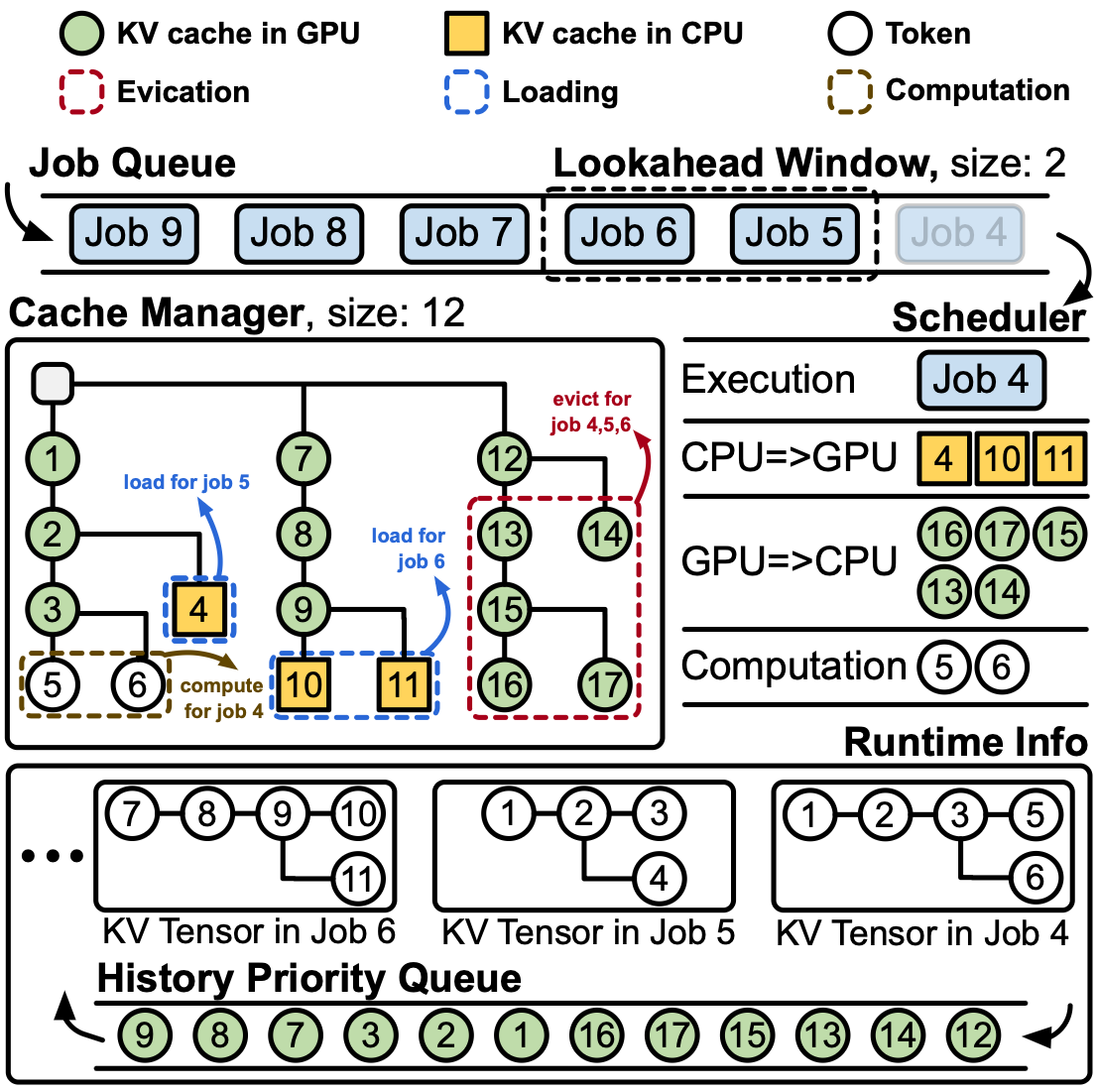
DepCache: A KV Cache Management Framework for GraphRAG with Dependency Attention
Hao Yuan, Xin Ai, Qiange Wang, Peizheng Li, Jiayang Yu, Chaoyi Chen, Xinbo Yang, Yanfeng Zhang, Zhenbo Fu, Yingyou Wen, Ge Yu
Special Interest Group on Management of Data (SIGMOD) 2026
We introduce dependency attention, a novel graph-aware attention mechanism that restricts attention computation to token pairs with structural dependencies in the retrieved subgraph. Unlike standard self-attention that computes fully connected interactions, dependency attention prunes irrelevant token pairs and reuses computations along shared relational paths, substantially reducing inference overhead. Building on this idea, we develop DepCache, a KV cache management framework tailored for dependency attention.
DepCache: A KV Cache Management Framework for GraphRAG with Dependency Attention
Hao Yuan, Xin Ai, Qiange Wang, Peizheng Li, Jiayang Yu, Chaoyi Chen, Xinbo Yang, Yanfeng Zhang, Zhenbo Fu, Yingyou Wen, Ge Yu
Special Interest Group on Management of Data (SIGMOD) 2026
We introduce dependency attention, a novel graph-aware attention mechanism that restricts attention computation to token pairs with structural dependencies in the retrieved subgraph. Unlike standard self-attention that computes fully connected interactions, dependency attention prunes irrelevant token pairs and reuses computations along shared relational paths, substantially reducing inference overhead. Building on this idea, we develop DepCache, a KV cache management framework tailored for dependency attention.
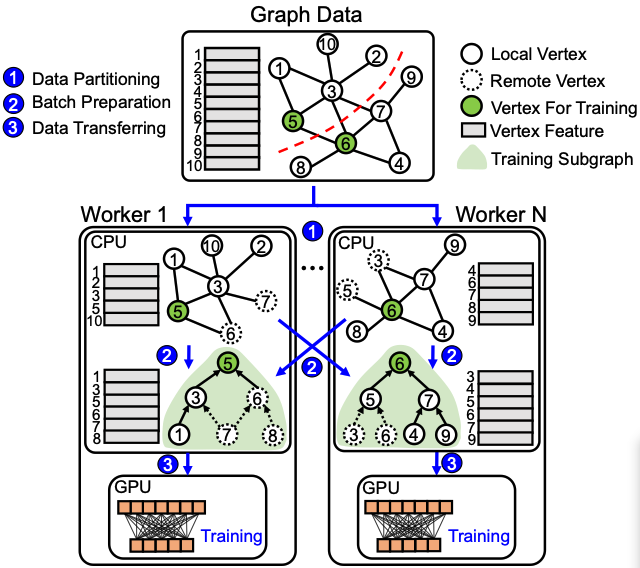
Comprehensive Evaluation of GNN Training Systems: A Data Management Perspective
Hao Yuan, Yajiong Liu, Yanfeng Zhang, Xin Ai, Qiange Wang, Chaoyi Chen, Yu Gu, Ge Yu
Very Large Data Bases (VLDB) 2024
This paper reviews GNN training from a data management perspective and provides a comprehensive analysis and evaluation of the representative approaches. We conduct extensive experiments on various benchmark datasets and show many interesting and valuable results. We also provide some practical tips learned from these experiments, which are helpful for designing GNN training systems in the future.
Comprehensive Evaluation of GNN Training Systems: A Data Management Perspective
Hao Yuan, Yajiong Liu, Yanfeng Zhang, Xin Ai, Qiange Wang, Chaoyi Chen, Yu Gu, Ge Yu
Very Large Data Bases (VLDB) 2024
This paper reviews GNN training from a data management perspective and provides a comprehensive analysis and evaluation of the representative approaches. We conduct extensive experiments on various benchmark datasets and show many interesting and valuable results. We also provide some practical tips learned from these experiments, which are helpful for designing GNN training systems in the future.